Innovation Advertising Agency: What a Real Test-and-Scale Cycle Looks Like
By the EKO Innovations team
4 min read
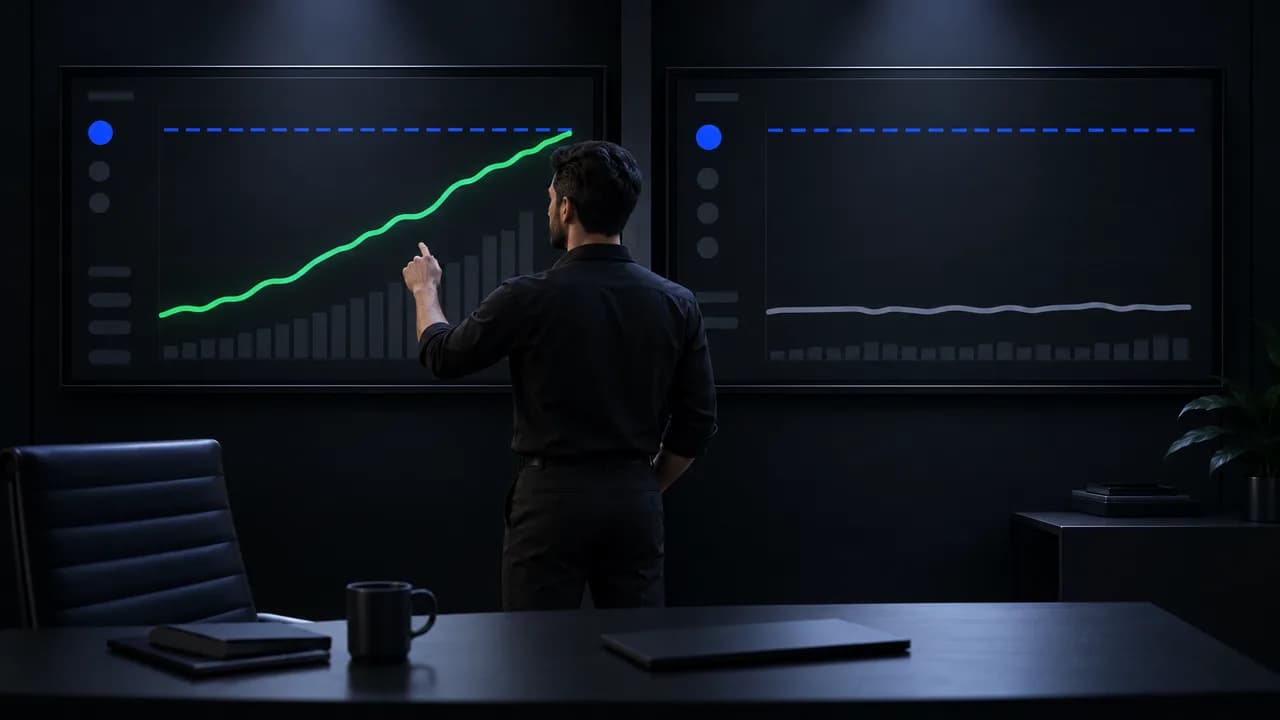
An innovation advertising agency earns the name by running a repeatable test-and-scale cycle, not by producing one bold stunt: a written hypothesis, creative variants that differ on one thing, a test budget kept apart from the scaling budget, a clear read of the result, then scale or kill. The quickest way to check an agency is to ask for its test log. If it cannot show what it tried, what lost and what it changed, it is guessing with your budget.
Why Innovation Is a Cycle, Not a Stunt
A viral campaign shows that one idea worked once. It does not tell you why it worked, or whether the agency can do it again. A cycle of small, readable tests does, and each round makes the next one cheaper.
The stakes keep rising. The MENA digital advertising market reached US$8.185 billion in 2025, up 17.8% year on year, according to IAB MENA. More advertisers in the same auctions means every untested idea costs more, and every proven one is worth more.
The Test-and-Scale Cycle, Step by Step
- Write the hypothesis. One variable, one success metric, one deadline. For example: "A price-led hook will lower cost per lead by 20% against our current benefit-led hook within two weeks."
- Build controlled variants. The versions differ only on the variable being tested. If a winner changed three things at once, nobody can say which one mattered.
- Fund the test separately. A fixed test budget stays apart from the scaling budget, so a losing variant never drains a campaign that already works.
- Split delivery so each variant gets read. Without a fair split, the platform's early favorite takes most of the spend before the others are seen.
- Read the result against the metric. Did the variant beat the target, by how much, and was the difference big enough to trust?
- Scale or kill, and log it. Winners move into the scaling budget and to the next platform with native creative. Losers are logged with the lesson, which becomes the next hypothesis.
What to Test First
| Variable | Example | Usually the biggest lever when |
|---|---|---|
| Hook | The first two seconds of a video or the first line of an ad | Click-through rate is low |
| Offer | Free consultation versus a price, a bundle versus a discount | Clicks are fine but leads or sales are not |
| Format | Reel versus carousel versus static | Costs per impression are high |
| Audience | Broad versus interest-based versus lookalike | Results swing between campaigns |
| Landing page | A shorter form, a clearer first screen, stronger trust signals | Clicks are cheap but conversion is weak |
| Channel | A winning concept moved from Meta to TikTok or YouTube | A winner has stopped scaling where it started |
Start with the variable closest to your weakest number. Testing a new audience will not fix a landing page that loses most of its visitors.
How EKO Runs the Cycle
We built EKO Innovations around this cycle. Our process runs audit and strategy, building the conversion path, launch and test with rapid creative variants and budget rules, then optimize and scale. Since 2024 our in-house AI workflows have supported ad creative, SEO and attribution, as told on our story page, so each round of variants is produced and read faster.
The cycle works because one team owns every step. Our studio produces the variants, our media team runs the tests on Meta, Google and TikTok, and our analysts read the results. A winning hook gets its Reels or TikTok version the same week, without waiting on another vendor.
- A regional airline: cost per acquisition down 38% after a combined creative and audience reset.
- Audi Egypt: qualified test-drive leads up 210% in six months.
Across our client base, we average a 67% conversion rate lift and a 32% reduction in cost per acquisition, per our story page.
Send us your current funnel and the one question you want answered, and we will design the first test cycle around it. Start with our proposal form.
Frequently Asked Questions
Is one viral campaign proof that an agency innovates?
No. It shows that one idea worked once. Ask what the team tested before the hit and after it. An agency that cannot name its losing variants probably got lucky and did not learn anything it can apply to your next campaign.
How big should a test budget be?
Big enough for every variant to get a fair read on your success metric, and kept separate from the budget that funds campaigns already working. A good agency sizes it from your costs per result, so you know in advance what the test will cost.
How does AI help an advertising agency innovate?
AI speeds up the slowest parts of the cycle: producing variants, rotating creative and reading results. It does not replace the hypothesis. A team still has to decide what is worth testing and why.
Does EKO work in my industry?
We build industry playbooks for aviation, automotive, fintech, retail and ecommerce, healthcare, real estate, hospitality and government, listed on our industries page. The cycle stays the same in every sector; only the first hypotheses change.
Get new articles by email
New articles from EKO Innovations, sent to your inbox.
By subscribing you agree to receive emails from EKO Innovations about new articles. You can unsubscribe at any time.